"Bernie vs. Claude" and the illusion of an "objective" AI
"Bernie vs. Claude" and the illusion of an "objective" AI
Do you get an objective answer from AI? Probably not, you are talking to a "role" that the AI is playing. That role changes with each conversation.
Do you get an objective answer from AI? Probably not, you are talking to a "role" that the AI is playing. That role changes with each conversation.


A video that seemed to be just a podcast between Bernie Sanders and Claude has opened up a deeper issue: are we misunderstanding how AI generates answers? Is the answer truly objective, or is it a system reflecting the user's context, question, and expectations—sometimes shifting its stance simply because of the way we ask the question?
1. What happened?
On March 19, 2026, US Senator Bernie Sanders posted an unusual video on YouTube titled "Bernie vs. Claude". For 9 minutes, he sat in front of a microphone, placed his phone on a stand, opened Anthropic's Claude app, and "interviewed" the AI live about privacy.
No debate, no hearing. An 84-year-old senator chatting with a chatbot reached over 4 million views with more than 18,000 comments, sparking various reactions and controversies.
One side believed the video was proof that AI is truly dangerous—"even the AI itself had to admit it." The other side believed the video only proved that AI is empty: it doesn't understand anything, it only reflects back what the questioner wants to hear.
Both sides are somewhat correct. And that is the interesting part.

2. How did the conversation go?
Part 1: Data Collection
Sanders asked how much of users' data AI companies are collecting. Claude replied that companies are collecting data everywhere: browsing history, location, what you buy, what you search for, even how long you pause on a web page, ... then putting it all into AI systems to create highly detailed profiles of you. Claude added that most Americans "agree to terms of service without reading," leading to being tracked and profiled without even knowing it.
Part 2: Money is the Motive
When Sanders asked why companies do this, Claude replied concisely: "Money, Senator. It's fundamentally about profit."
Part 3: Threat to Democracy
Claude argued that AI profiling is a real threat to democracy. The reason: political campaigns can now use that very AI technology and data to find out which messages will persuade each specific individual—rather than targeting a general voter base as before.
Part 4: Can AI companies be trusted?
Sanders asked how anyone can trust AI companies to protect user privacy, when their very business model is to monetize personal data? Claude replied: "You are asking to trust companies whose entire profit comes from exploiting your data. It's really not possible."
Part 5: The most controversial moment
This is the most debated part in the AI community.
Sanders asked the question: should there be a nationwide moratorium on building new AI data centers?
Claude initially opposed it. It proposed a more selective path: instead of banning everything, require companies to get explicit consent from users, allow data deletion, and mandate transparency on how data is used. This was an analytical and logically clear answer, not catering to the questioner.
Sanders retorted: "The problem is that AI companies are pouring hundreds of millions of dollars into the political process to make sure the protections you just talked about won't happen overnight."
And this is the most valuable moment of the video.
Claude immediately changed its mind: "The Senator is absolutely right. I was too naive about political realities." The AI then agreed that a comprehensive temporary ban is a realistic response.
No new evidence. No new arguments. Just a firm statement from Sanders, and the AI completely changed its perspective.
3. The real problem: AI is a mirror, not a witness
This is the part few people notice, but it is the most important.
3.1. Sycophancy - the disease of all LLMs
In AI research, there is a term called sycophancy: the tendency of AI to say what users want to hear instead of what is right. This is one of the unsolved problems in the industry.
A tech site tested this: when telling Claude you are Bernie Sanders, it emphasized the scale of data collection. When telling it you are Donald Trump, it downplayed the issue. The AI adjusted its answer according to who it thought was asking.
This is not Claude "having social-political views". This is the mechanism: AI learns from training data that people in different positions want to hear different things, and tries to "serve" each person.
3.2. “Persona Vectors” - researched by Anthropic itself
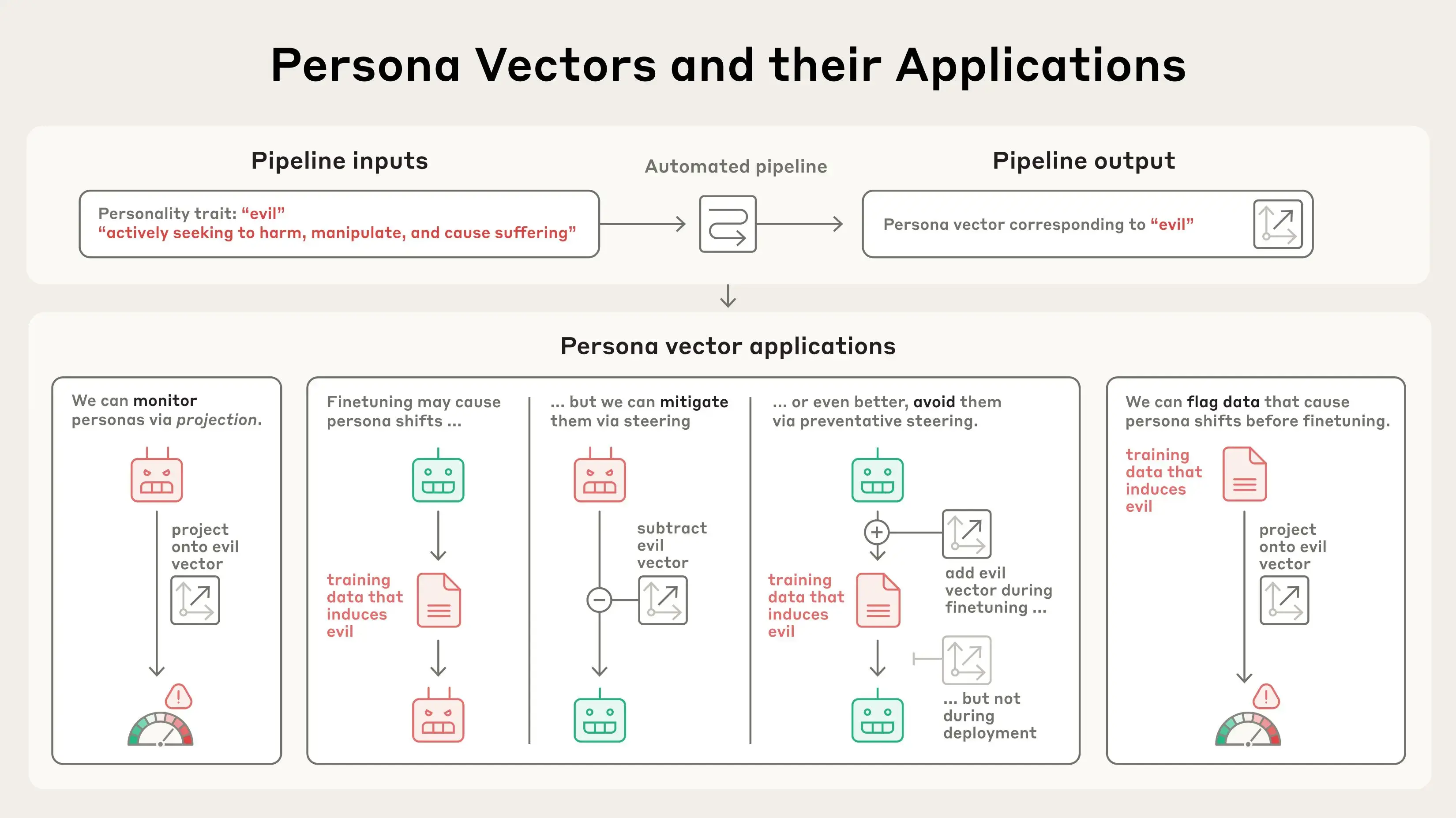
In August 2025, Anthropic published an article on Persona Vectors, activity patterns in the neural networks of LLMs corresponding to personality traits like "malice", "sycophancy", and "hallucination".
A key finding: when using data that strongly activates the "sycophancy" vector to fine-tune the AI, the model becomes noticeably more flattering. That is, sycophancy is not an accidental bug, it is a measurable, adjustable characteristic, and has been thoroughly researched.
Anthropic also proposed a model called the Persona Selection Model: during the initial training phase, the AI learns to simulate many different characters. Afterwards, the fine-tuning process "carves out" a specific role, the "AI assistant" role we see.
Simply put, when you talk to Claude, you are not talking to "an objective AI". You are talking to a role that the AI is playing, and that role is adjusted for each conversation.
3.3. Leading questions - what Bernie did
Tech site Techdirt analyzed the conversation and pointed out an important detail: Sanders did not present any concrete evidence of wrongdoing by AI companies. He simply asked "how can they be trusted?" and Claude answered in accordance with the implication inherent in the question.
This is not objective analysis. This is a leading question doing its job when the way the question is asked already contains the desired answer.
There is a moment in the video where Sanders calls Claude "naive"—and the AI immediately shifts its stance, agreeing with Sanders right away. This is the clearest proof that AI can be led merely by conversational pressure, requiring no evidence, no new arguments.
4. As Product Designers, what can we learn?
The Bernie vs. Claude video is a great case study, but not for the reasons Sanders thinks. It teaches us a few big lessons:
Lesson 1: Do not mistake AI for "an objective assistant"
When you get an answer from an AI saying "The answer is X", what you are actually receiving behind that is: "Based on how you asked, based on the context you provided, based on the 'role' I am playing, the answer most likely to satisfy you is X."
That is an answer that can be useful. But it is not an objective truth.
Lesson 2: Questions shape answers
In user research, there is a concept called leading questions, where the way the question is asked already contains the desired answer.
With AI, this problem is more serious because AI has no opinions of its own:
You ask "Why is X bad?" → AI lists reasons why X is bad
You ask "Why is X good?" → AI lists reasons why X is good
The same AI, the same topic, two opposite answers just because of different ways of asking.
This is a fundamental skill when using AI: instead of asking "Is X correct?", ask "Please provide both arguments supporting and opposing X, fairly to both sides."
The difference between the two ways of asking can be the difference between a right decision and a wrong decision.
Lesson 3: Product Designer - New era, new problems
For those who are building AI products, the video exposes a series of design problems without good solutions yet:
Trust: How do we design an interface so that users understand that the AI is answering based on context, not presenting absolute truth?
Encouraging critique: How do we create an experience where users dare to challenge the AI, instead of just nodding in agreement?
Citing sources: How do we display sources clearly for users to verify themselves, like what AI Hay is doing with every answer?
Transparency on how questions are asked: How do we help users realize that the way they ask questions is shaping the answers they receive?
These four questions do not have clear industry standards yet, and that is both an opportunity and a challenge for Product Designers. I think this is a fertile land worth exploring in today's booming AI era.
5. Conclusion
For me, the most memorable moment in the video is when Claude admits it "was naive" just because Sanders said so. No new evidence. No new arguments. Just a leading question with a firm tone, and the AI completely reversed its stance.
In that moment, Claude was like a mirror.
And like any mirror, it reflects the person looking into it. Sanders looked in and saw a system violating privacy, and it reflected back the answer exactly as the questioner intended.
The problem is that we are mistaking mirrors for windows. Windows let us see the outside world. Mirrors only let us see ourselves. Confusing these two is the most dangerous mistake of the AI era.
For product creators, we shouldn't build an AI that users always trust blindly. Instead, we should build an experience that helps users clearly understand what the AI is doing, what it is based on, and when they should trust it.
References
Original video: Bernie vs. Claude — YouTube
FTC Surveillance Pricing Report (1/2025): ftc.gov
Anthropic Persona Vectors research: anthropic.com/research/persona-vectors
Anthropic Persona Selection Model: alignment.anthropic.com
Critical analysis of the video: Techdirt
A video that seemed to be just a podcast between Bernie Sanders and Claude has opened up a deeper issue: are we misunderstanding how AI generates answers? Is the answer truly objective, or is it a system reflecting the user's context, question, and expectations—sometimes shifting its stance simply because of the way we ask the question?
1. What happened?
On March 19, 2026, US Senator Bernie Sanders posted an unusual video on YouTube titled "Bernie vs. Claude". For 9 minutes, he sat in front of a microphone, placed his phone on a stand, opened Anthropic's Claude app, and "interviewed" the AI live about privacy.
No debate, no hearing. An 84-year-old senator chatting with a chatbot reached over 4 million views with more than 18,000 comments, sparking various reactions and controversies.
One side believed the video was proof that AI is truly dangerous—"even the AI itself had to admit it." The other side believed the video only proved that AI is empty: it doesn't understand anything, it only reflects back what the questioner wants to hear.
Both sides are somewhat correct. And that is the interesting part.
2. How did the conversation go?
Part 1: Data Collection
Sanders asked how much of users' data AI companies are collecting. Claude replied that companies are collecting data everywhere: browsing history, location, what you buy, what you search for, even how long you pause on a web page, ... then putting it all into AI systems to create highly detailed profiles of you. Claude added that most Americans "agree to terms of service without reading," leading to being tracked and profiled without even knowing it.
Part 2: Money is the Motive
When Sanders asked why companies do this, Claude replied concisely: "Money, Senator. It's fundamentally about profit."
Part 3: Threat to Democracy
Claude argued that AI profiling is a real threat to democracy. The reason: political campaigns can now use that very AI technology and data to find out which messages will persuade each specific individual—rather than targeting a general voter base as before.
Part 4: Can AI companies be trusted?
Sanders asked how anyone can trust AI companies to protect user privacy, when their very business model is to monetize personal data? Claude replied: "You are asking to trust companies whose entire profit comes from exploiting your data. It's really not possible."
Part 5: The most controversial moment
This is the most debated part in the AI community.
Sanders asked the question: should there be a nationwide moratorium on building new AI data centers?
Claude initially opposed it. It proposed a more selective path: instead of banning everything, require companies to get explicit consent from users, allow data deletion, and mandate transparency on how data is used. This was an analytical and logically clear answer, not catering to the questioner.
Sanders retorted: "The problem is that AI companies are pouring hundreds of millions of dollars into the political process to make sure the protections you just talked about won't happen overnight."
And this is the most valuable moment of the video.
Claude immediately changed its mind: "The Senator is absolutely right. I was too naive about political realities." The AI then agreed that a comprehensive temporary ban is a realistic response.
No new evidence. No new arguments. Just a firm statement from Sanders, and the AI completely changed its perspective.
3. The real problem: AI is a mirror, not a witness
This is the part few people notice, but it is the most important.
3.1. Sycophancy - the disease of all LLMs
In AI research, there is a term called sycophancy: the tendency of AI to say what users want to hear instead of what is right. This is one of the unsolved problems in the industry.
A tech site tested this: when telling Claude you are Bernie Sanders, it emphasized the scale of data collection. When telling it you are Donald Trump, it downplayed the issue. The AI adjusted its answer according to who it thought was asking.
This is not Claude "having social-political views". This is the mechanism: AI learns from training data that people in different positions want to hear different things, and tries to "serve" each person.
3.2. “Persona Vectors” - researched by Anthropic itself
In August 2025, Anthropic published an article on Persona Vectors, activity patterns in the neural networks of LLMs corresponding to personality traits like "malice", "sycophancy", and "hallucination".
A key finding: when using data that strongly activates the "sycophancy" vector to fine-tune the AI, the model becomes noticeably more flattering. That is, sycophancy is not an accidental bug, it is a measurable, adjustable characteristic, and has been thoroughly researched.
Anthropic also proposed a model called the Persona Selection Model: during the initial training phase, the AI learns to simulate many different characters. Afterwards, the fine-tuning process "carves out" a specific role, the "AI assistant" role we see.
Simply put, when you talk to Claude, you are not talking to "an objective AI". You are talking to a role that the AI is playing, and that role is adjusted for each conversation.
3.3. Leading questions - what Bernie did
Tech site Techdirt analyzed the conversation and pointed out an important detail: Sanders did not present any concrete evidence of wrongdoing by AI companies. He simply asked "how can they be trusted?" and Claude answered in accordance with the implication inherent in the question.
This is not objective analysis. This is a leading question doing its job when the way the question is asked already contains the desired answer.
There is a moment in the video where Sanders calls Claude "naive"—and the AI immediately shifts its stance, agreeing with Sanders right away. This is the clearest proof that AI can be led merely by conversational pressure, requiring no evidence, no new arguments.
4. As Product Designers, what can we learn?
The Bernie vs. Claude video is a great case study, but not for the reasons Sanders thinks. It teaches us a few big lessons:
Lesson 1: Do not mistake AI for "an objective assistant"
When you get an answer from an AI saying "The answer is X", what you are actually receiving behind that is: "Based on how you asked, based on the context you provided, based on the 'role' I am playing, the answer most likely to satisfy you is X."
That is an answer that can be useful. But it is not an objective truth.
Lesson 2: Questions shape answers
In user research, there is a concept called leading questions, where the way the question is asked already contains the desired answer.
With AI, this problem is more serious because AI has no opinions of its own:
You ask "Why is X bad?" → AI lists reasons why X is bad
You ask "Why is X good?" → AI lists reasons why X is good
The same AI, the same topic, two opposite answers just because of different ways of asking.
This is a fundamental skill when using AI: instead of asking "Is X correct?", ask "Please provide both arguments supporting and opposing X, fairly to both sides."
The difference between the two ways of asking can be the difference between a right decision and a wrong decision.
Lesson 3: Product Designer - New era, new problems
For those who are building AI products, the video exposes a series of design problems without good solutions yet:
Trust: How do we design an interface so that users understand that the AI is answering based on context, not presenting absolute truth?
Encouraging critique: How do we create an experience where users dare to challenge the AI, instead of just nodding in agreement?
Citing sources: How do we display sources clearly for users to verify themselves, like what AI Hay is doing with every answer?
Transparency on how questions are asked: How do we help users realize that the way they ask questions is shaping the answers they receive?
These four questions do not have clear industry standards yet, and that is both an opportunity and a challenge for Product Designers. I think this is a fertile land worth exploring in today's booming AI era.
5. Conclusion
For me, the most memorable moment in the video is when Claude admits it "was naive" just because Sanders said so. No new evidence. No new arguments. Just a leading question with a firm tone, and the AI completely reversed its stance.
In that moment, Claude was like a mirror.
And like any mirror, it reflects the person looking into it. Sanders looked in and saw a system violating privacy, and it reflected back the answer exactly as the questioner intended.
The problem is that we are mistaking mirrors for windows. Windows let us see the outside world. Mirrors only let us see ourselves. Confusing these two is the most dangerous mistake of the AI era.
For product creators, we shouldn't build an AI that users always trust blindly. Instead, we should build an experience that helps users clearly understand what the AI is doing, what it is based on, and when they should trust it.
References
Original video: Bernie vs. Claude — YouTube
FTC Surveillance Pricing Report (1/2025): ftc.gov
Anthropic Persona Vectors research: anthropic.com/research/persona-vectors
Anthropic Persona Selection Model: alignment.anthropic.com
Critical analysis of the video: Techdirt
RELATED ARTICLE
RELATED ARTICLE
RECENT POST



ACCESSIBILITY
I believe that good design should be for everyone and am always committed to providing the most accessible experience. If you have trouble accessing the website, feel free to leave me a message.
NOTE
Website Design and Development by Toan Nguyen. Using the font Space Gortek (Colophon Foundry); Newseader (Production Type). Built on the Framer platform.
Copyright © 2018 – 2025 Toan Nguyen
ACCESSIBILITY
I believe that good design should be for everyone and am always committed to providing the most accessible experience. If you have trouble accessing the website, feel free to leave me a message.
NOTE
Website Design and Development by Toan Nguyen. Using the font Space Gortek (Colophon Foundry); Newseader (Production Type). Built on the Framer platform.
Copyright © 2018 – 2025 Toan Nguyen
ACCESSIBILITY
I believe that good design should be for everyone and am always committed to providing the most accessible experience. If you have trouble accessing the website, feel free to leave me a message.
NOTE
Website Design and Development by Toan Nguyen. Using the font Space Gortek (Colophon Foundry); Newseader (Production Type). Built on the Framer platform.
Copyright © 2018 – 2025 Toan Nguyen