An overview of the Double Diamond design thinking process #1
In today's era of digital technology combined with AI, the pace of product development has become dizzying. But haste often leads to the most expensive mistake of all: a product that works well, yet nobody wants to use because it solves the wrong problem.


About This Series
This series introduces the Double Diamond, a Design Thinking framework that helps teams understand the problem correctly before looking for a solution.
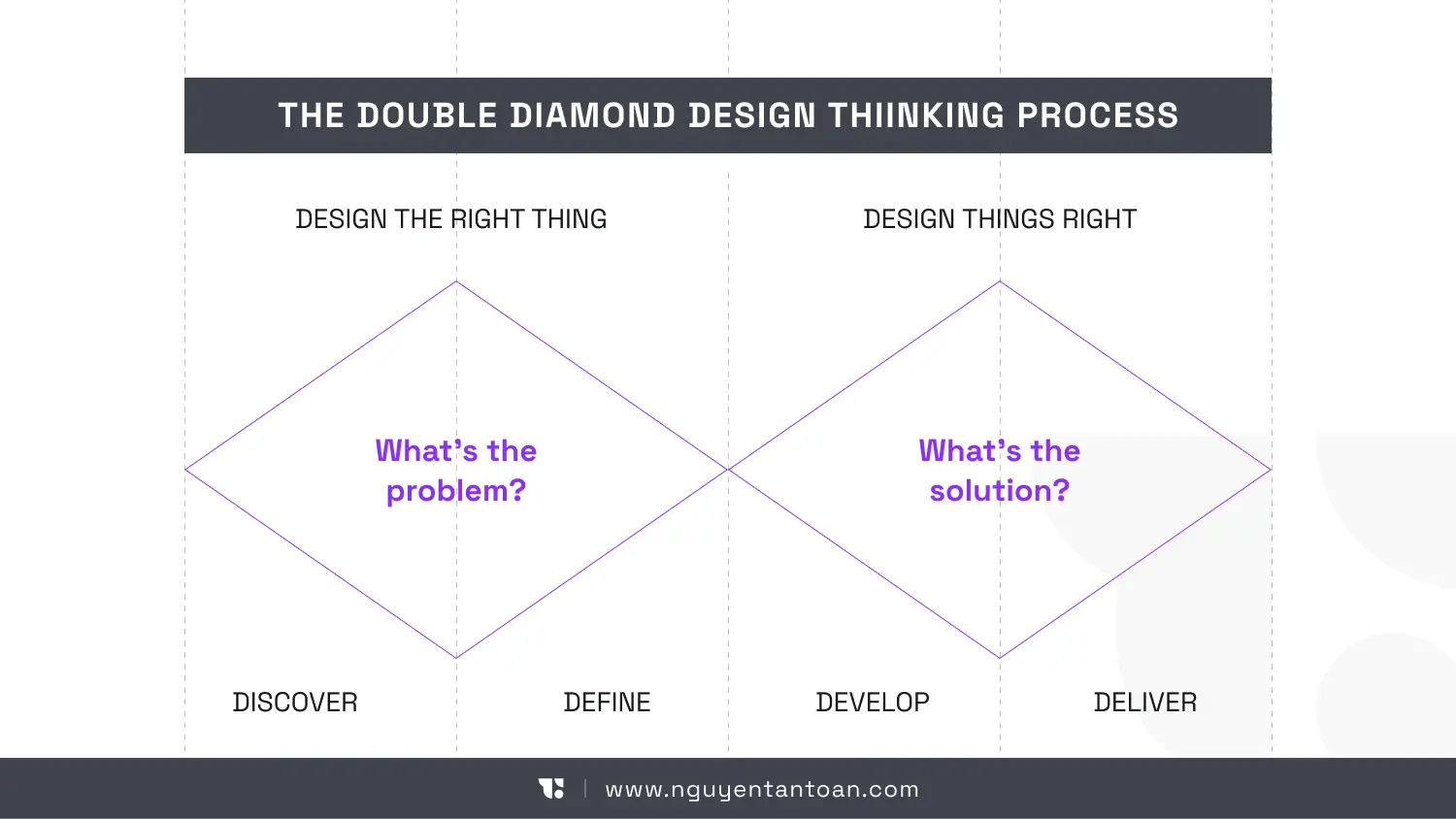
The process has two parts: the Problem Space (Discover, Define), for exploring and defining the problem, and the Solution Space (Develop, Deliver), for developing and validating the solution. At the heart of the Double Diamond is the combination of widening and narrowing your thinking in order to reduce risk when designing a product.
The Difference Between a Good Product and a Great One
In today's era of digital technology combined with AI, the pace of product development has become dizzying. But haste often leads to the most expensive mistake of all: a product that works well and packs in plenty of features, yet nobody uses because it solves the wrong problem. For a product team, the pressure to ship a solution quickly is immense, but getting the strategic direction right matters even more.
The Double Diamond emerged as a lighthouse, offering a clear, systematic path to guide innovation. It turns a chaotic design process into a risk-management methodology that is measurable and repeatable. This article opens a series on how to apply the Double Diamond in Product Design.
What Is the Double Diamond?
The Double Diamond is a model published by the Design Council in 2004, though its core philosophy had long been practiced by designers and innovators. It systematizes problem solving by dividing the process into four distinct phases that form two consecutive "diamonds".
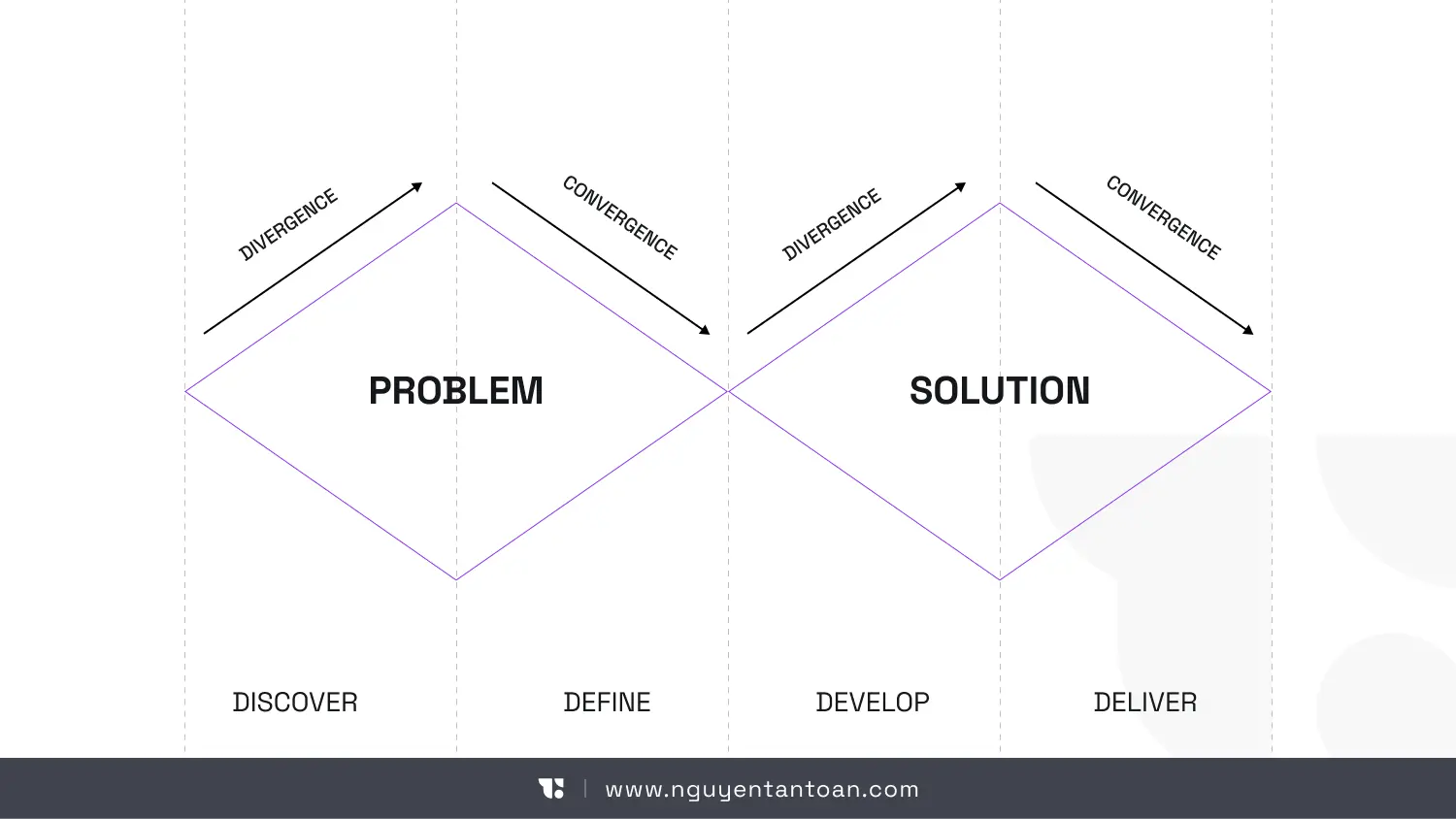
1. The Principle of Divergence and Convergence
Design thinking always calls for a constructive tension between opening up and narrowing down:
- Divergent Thinking - Opening Up. This is when we open our minds and gather information, perspectives, raw data, ideas, and observations. The goal is to explore the full breadth of the problem, or to listen to possible solutions without judgment, uncovering depths not yet known.
- Convergent Thinking - Narrowing Down. This is when we step back to analyze, filter, and synthesize all the data we have collected. The goal is to distill that breadth into a clear focus, a set of sharp insights, or a specific decision.
Each "diamond" is a complete loop (Diverge → Converge), ensuring that focus is always balanced by thorough exploration.
2. Two Spaces, Two Strategies
The model's two-diamond structure splits the process into two spaces with different goals and approaches. This is the crux of managing risk:
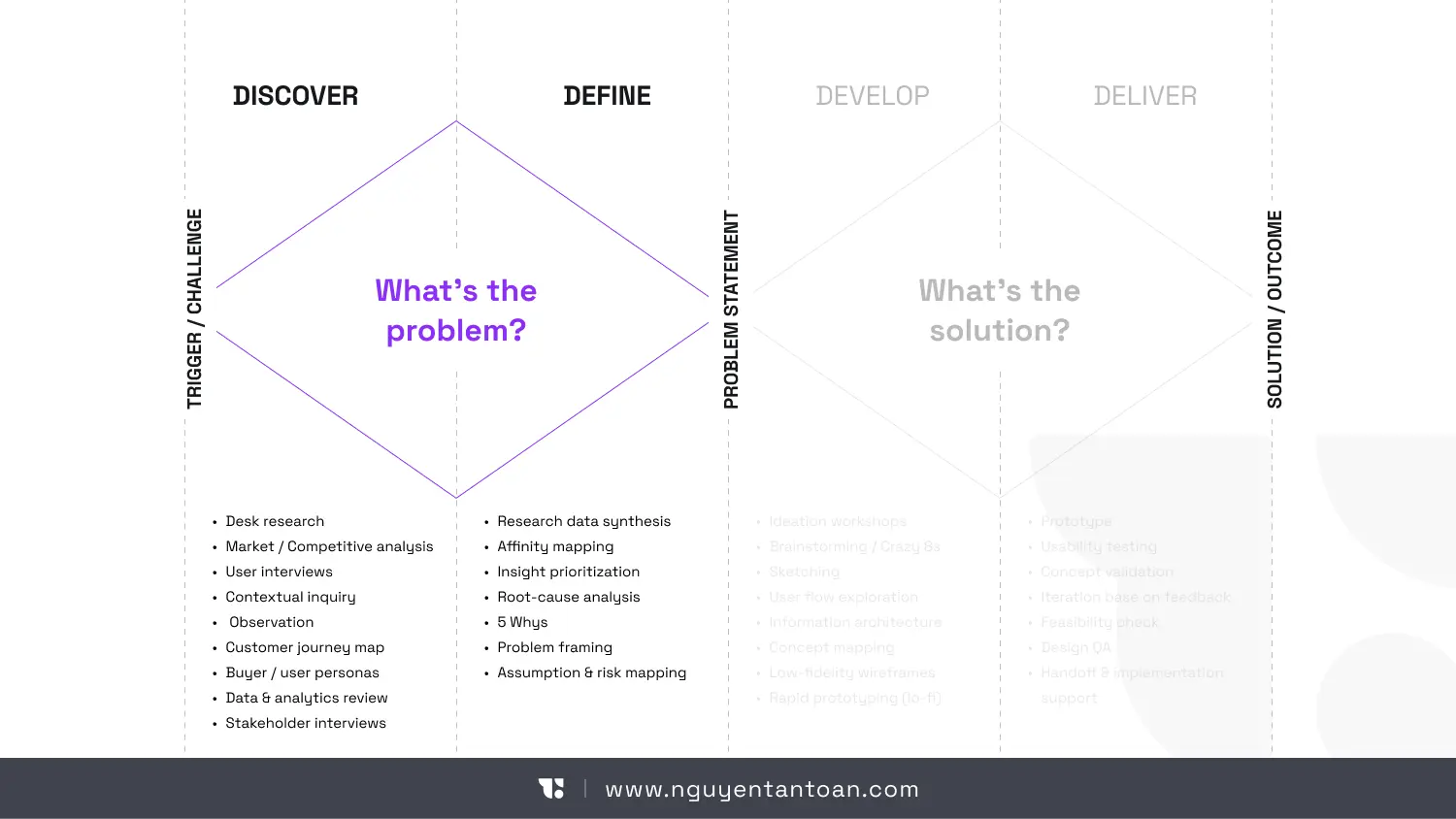
2.1 Diamond 1: The Problem Space
- Phases: Discover and Define.
- Strategic goal: "Design the Right Thing". The task is to understand users deeply: their needs, their pain points, and their context.
- Core value: Preventing resources from being wasted on building a solution to a problem that does not exist or does not matter. The end result is a clear Problem Statement.
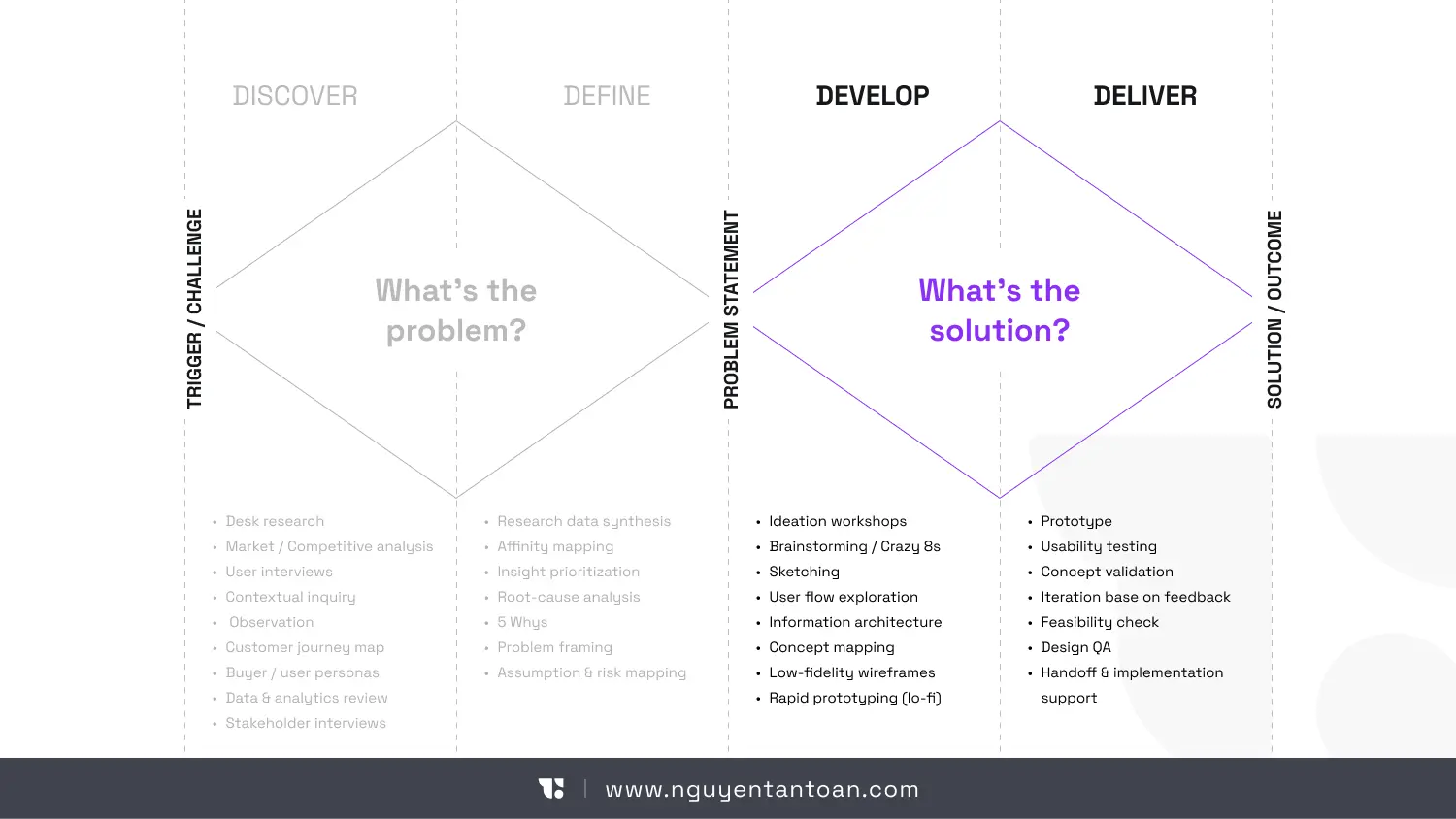
2.2 Diamond 2: The Solution Space
- Phases: Develop and Deliver.
- Strategic goal: "Design Things Right". The task is to create, test, iterate on, and ship the best solution to the problem defined in Diamond 1.
- Core value: Ensuring the solution is not only technically feasible but also meets user needs and business goals. The end result is a product or feature that has been validated and is ready to launch.
2.3 The Four Phases of the Process
The four phases (the 4 D's) of the Double Diamond are the backbone of every Product Design project.
| Phase | Mindset | Main Goal | Typical Activities | Key Deliverables |
|---|---|---|---|---|
| 1. Discover | Divergent | Understand the problem from many angles; build empathy. | Qualitative research (interviews), quantitative research (analytics), observation, competitor research. | Raw data, observations, user stories. |
| 2. Define | Convergent | Filter the data down to core insights; identify the real problem. | Data synthesis (affinity mapping), persona building, empathy mapping. | Problem statement, design brief, opportunity areas. |
| 3. Develop | Divergent | Generate many diverse solution ideas; experiment quickly. | Brainstorming, sketching, low-fidelity prototyping. | Multiple low/mid-fidelity prototypes, ideation list. |
| 4. Deliver | Convergent | Test, refine, and select the most viable solution to ship. | Usability testing, A/B testing, feasibility and viability analysis. | Minimum viable product (MVP), product roadmap, launched product. |
2.4 Application and Iteration
A common mistake is to treat the Double Diamond as a linear process that you run only once. In reality, it is an iterative framework.
- Nested diamonds: A large project usually contains one overarching diamond (product strategy) and many smaller diamonds nested inside it (the design of specific features).
- A continuous loop: Testing in the Deliver phase can surface new insights, forcing the team to return to the Discover phase and redefine the problem (in other words, start a new diamond). The process never ends. It keeps refining and optimizing the product.
2.5 An Example of How the Double Diamond Manages Risk
An FMCG company was in the early stages of researching and building a sales app for small neighborhood grocery stores. Beyond building order management and cash-flow reporting, the company planned to invest heavily in the interface and design a wide range of promotions to attract users. But when the team applied Diamond 1, they discovered that most shop owners only cared about which products were selling well in their area. They were not very interested in promotions, because if they stocked up and could not sell the goods, the goods would simply expire.
As a result, instead of pouring resources into an elaborate UI and a long list of offers, the team added a feature that recommends best-selling products by area (by product category, customer segment, and so on), and most users were happy with it. The Double Diamond helped them reduce the risk of investing in the wrong direction by moving from assumptions to evidence
Conclusion
The Double Diamond is a powerful tool that provides clear guidance and a sound structure, and it adapts to the many environments where sustainable innovation is needed. It is a shared language that cross-functional teams (Design, PM, Engineering, Marketing) can use to discuss risk, priorities, and value.
It is an affirmation that our work begins with empathy and discovery. By mastering Diamond 1, you lay a solid foundation for every success in product design.
References
- Design Council. The Double Diamond: A Framework for Innovation.
- Liedtka, J. (2018). Design Thinking for the Greater Good.
- Cooper, A. (2004). The Inmates Are Running the Asylum: Why High Tech Products Drive Us Crazy and How to Restore the Sanity.
- Nielsen Norman Group (NN/g). Various articles on Design Thinking and UX Processes.
- Ries, E. (2011). The Lean Startup.