With AI, building a product is no longer the hard part. The real difference comes after launch
I fully agree with one simple argument: the technical barrier to building a product has collapsed. But the difficulty has not disappeared, it has only moved somewhere else. It has shifted from "can you build it" to "can your product stay alive after launch".


The barrier really has collapsed ... but how far?
The term "vibe coding" came from a post by Andrej Karpathy on X in February 2025, where he described it as a state in which you "fully give in to the vibes, embrace exponentials, and forget that the code even exists". Less than two years later, Karpathy himself was the first to walk the term back: in April 2026, at Sequoia Capital's AI Ascent event, he declared vibe coding outdated and replaced it with "agentic engineering", the craft of designing systems of autonomous agents, a far more demanding discipline than the original picture of "relax, type a few sentences, done". By December 2025 he had already acknowledged that 80% of his own code was written by AI, but as the result of a tightly controlled process, not the "accept every change without looking" approach of the original definition.
That tells us something important: even the person who coined the term went from "just for fun, fine to throw the project away afterward" to "a genuinely disciplined way of working" in only 14 months. If an insider had to adjust that quickly, then the picture now circulating widely in the community, "one idea, one AI account and a server for a few dollars are enough to ship a product", is only true for the "zero to one" stage, from having nothing to having a product that exists. It says nothing about whether that product can survive.
Why "managing to build the product" is no longer the win
The data on startup failure shows a striking pattern, though not a new one. According to CB Insights' analysis of hundreds of startup post-mortems written by the founders themselves, the most frequently cited reason, at 42%, is "no real market need", far ahead of the second most common reason, "ran out of cash" (29%). Independent researchers have cited this figure consistently for years.
What matters here is that the 42% was measured across startups in general, from before vibe coding existed. In other words, even when "building the product" used to take real effort, money and time, the most common cause of failure still had nothing to do with building. Now that this barrier has all but vanished, intuition says the share of "nobody needs it" failures will grow even larger, because the things that once forced people to think hard before starting (cost and time) no longer act as a natural filter. Anyone can build a prototype in an afternoon, even when nobody has asked whether anyone needs it.
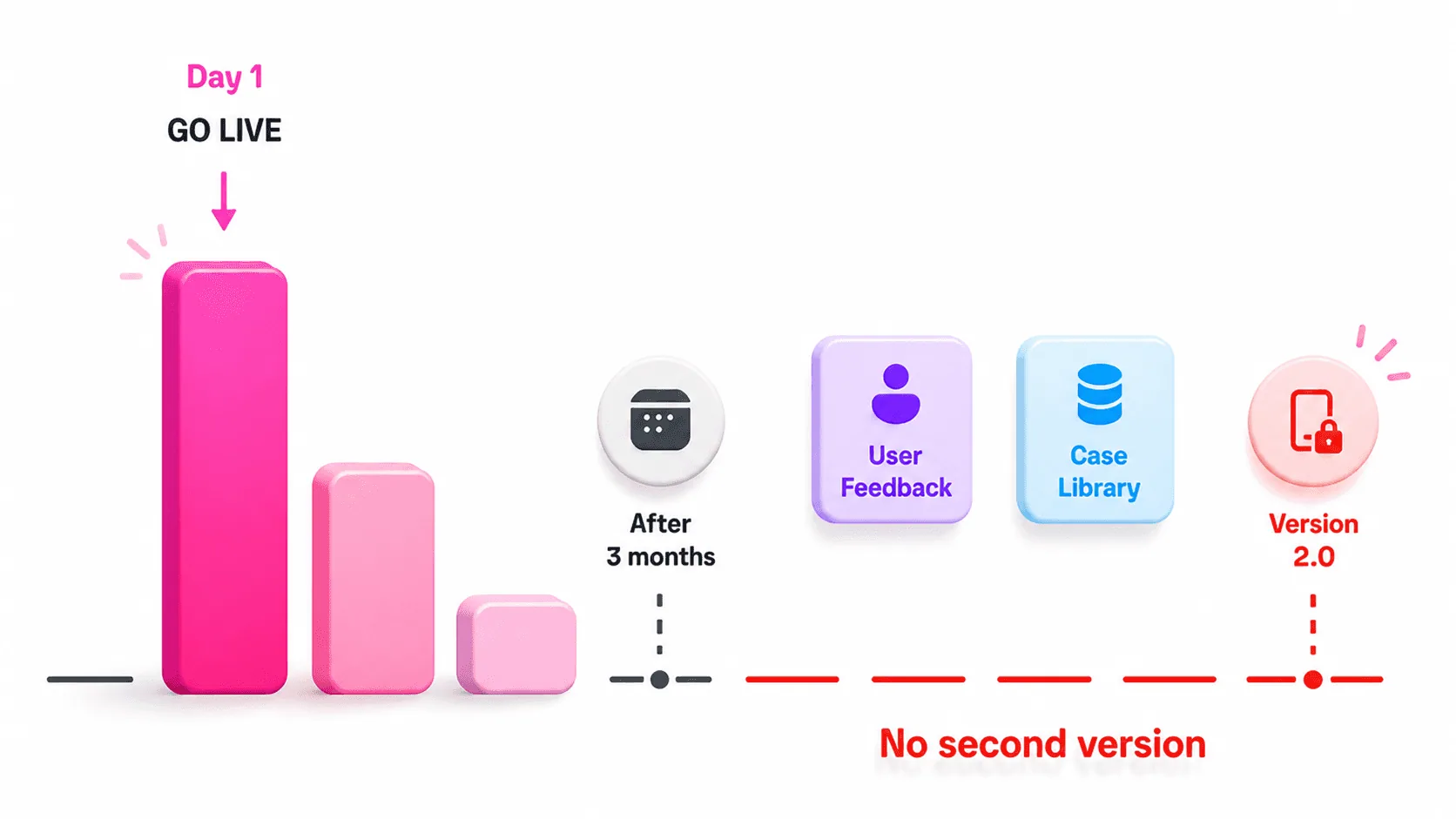
For many products, the first launch is the peak. Countless vibe-coded products show a dense commit graph during launch week and then go completely silent. Not because their authors are lazy or incapable. The problem is that nobody taught them what to do once the product works. Every guide to building AI products available today stops precisely at the moment of launch.
Why an AI product is never "finished"
This is the difference between AI products and traditional ones. Traditional software has hard-coded behavior: you write an if-else, and it runs exactly that way a million times in a row. An AI product is different. Its behavior is a sample drawn from a probability distribution at run time. That distribution shifts constantly: when the way users phrase their questions changes, when the knowledge base changes, and most importantly, when the model provider quietly updates the AI model you are using.
This is not speculation. A study by researchers at Stanford and UC Berkeley (Chen, Zaharia, Zou - "How Is ChatGPT's Behavior Changing over Time?", 2023) measured the phenomenon directly by comparing the same model version, called through the API, at two points three months apart. The results were startling: GPT-4's accuracy at identifying whether a number is prime dropped from about 84% (March 2023) to about 51% just three months later, because the model no longer followed step-by-step reasoning (chain-of-thought) the way it had before. The share of GPT-4's generated code that could be run right away also fell sharply, partly just because the model started automatically wrapping its code in triple backticks, a small formatting change, but enough to cause syntax errors at scale in any system that was automatically executing that code. The research team called this evidence that the behavior of the "same" LLM service can change substantially within a short period, and concluded that continuous monitoring is mandatory, not optional.
Put differently: even if you never touch a single line of your prompt, your product can still "break" over time, simply because the model provider updated things behind your back. This is why the idea of an AI product that is "finished, packaged and handed over", which holds for traditional software, no longer holds here.
Three jobs that begin after launch day
These three jobs are not done one after another. They run in parallel, all at once.
1. Tracking: turning user behavior into meaningful data
The most common mistake: counting on the "dislike" button. The share of users who actively press it is so low that it has no statistical meaning - a disappointed user's first reaction is not to leave a rating, it is to close the tab. The signals that are truly valuable are all passive and unintentional:
Don't count on "Like / Dislike" or "Rate this app" buttons. So few users actively press them that the numbers mean nothing statistically. Disappointed users simply close the tab, they don't sit around rating you. If you want to know what isn't working, look at these 4 signs:
- Users retry or ask again repeatedly (re-asking): the user rephrases to ask about the very same problem. This is the strongest failure signal because it is completely unconscious.
- Rewriting the question (rewriting): the user breaks the question into smaller parts, adds detailed conditions, and so on, which shows that the first answer was too generic.
- Abandoning midway: the user quits in the middle of an app flow or while an answer is being generated.
- Whether the result gets used: Is the result downloaded? Is the answer copied and put to use? However smart and advanced your system is, a result nobody can use is worthless.
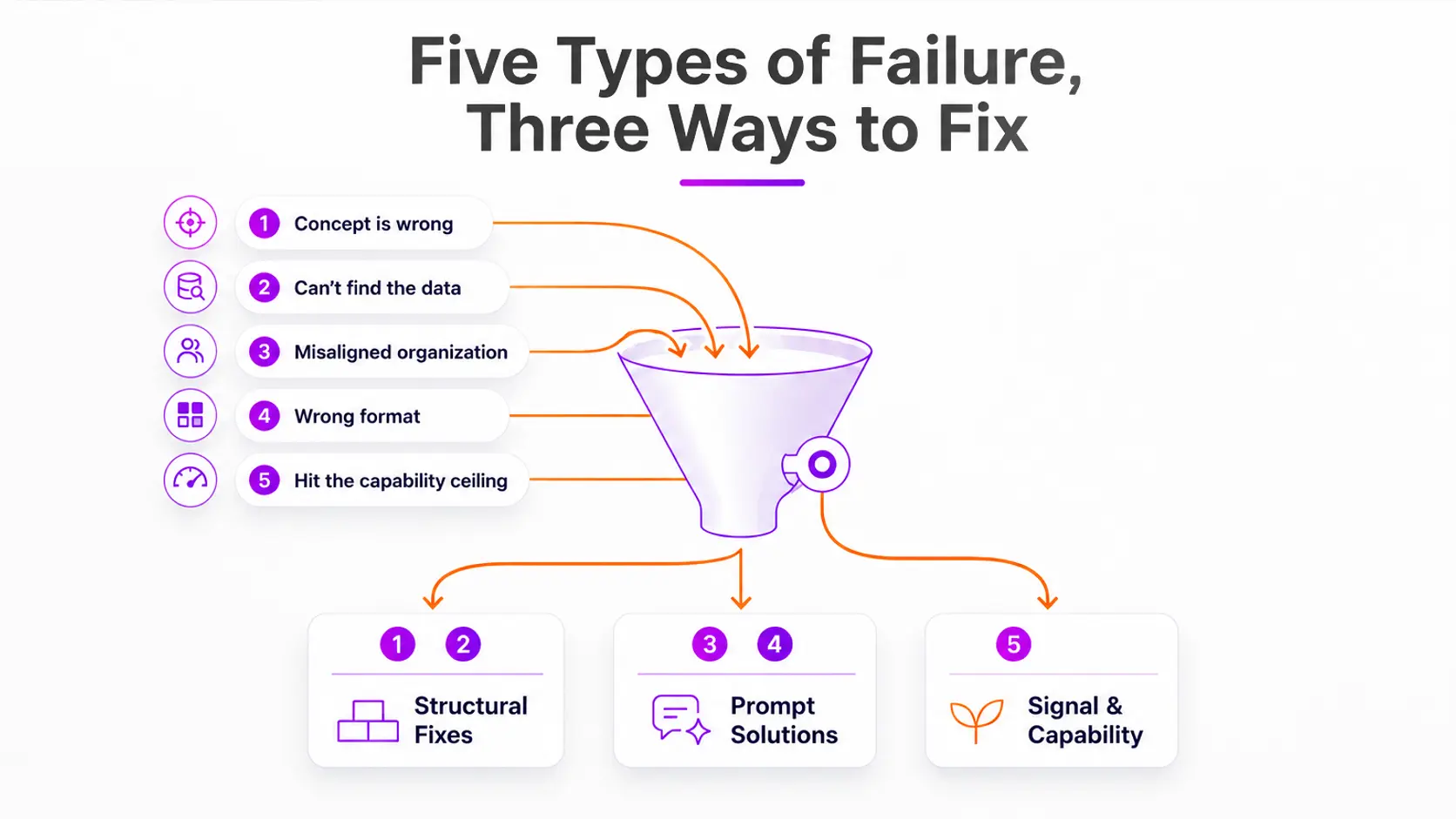
Failures must be classified by cause, not by feature module. This is the fundamental difference from traditional software QA, because the same symptom (a wrong answer) can come from five completely different causes: a prompt error, a retrieval error (retrieval didn't find the right document), truncated context, a genuine limit of the model's capability, or, most importantly, not an error at all but a user telling you which feature your product should build next.
Every failure case has to be turned into a re-runnable test case so the error can be tracked down: what the input is, what the expected behavior is, what the evaluation criteria are. Do this, and a few hundred accumulated cases become your own private benchmark, something no competitor can copy, because it is built up over time: if they start today, they will still need three months to catch up with the data you have today.
2. Iteration: knowing when to fix, and at what level
The most common mistake: fixing the prompt "case by case". By the 30th fix, the prompt has become a two-thousand-word document in which you don't dare delete a single line, because you no longer know which lines are actually doing anything. The principle to hold on to: only make a fix when a group of failures with the same cause has accumulated enough volume to confirm it is a recurring type. Never fix for a single isolated case.
And before fixing anything, you need to tell two kinds of problems apart:
- Fixable with the prompt: Problems of wording, format or tone. The AI knows how to do the task, it just isn't doing it the way you want yet.
- Not fixable with the prompt: It needs a new tool, needs to be split into several steps, needs an additional reference source, or needs a human to step in. The AI does not have enough information or capability to do it on its own in one pass.
A simple self-check: if you find yourself writing a long explanatory passage in the prompt to "teach" the model a workflow or a way of reasoning, it is almost certainly a structural problem, not a prompt problem.
3. Model: monitoring whether the AI running underneath changes on its own
This is the easiest job to overlook because, as the evidence above shows, model behavior can change even when you do nothing. The product can still "break" out of nowhere over time, simply because the AI provider quietly updated the model.
So the test suite you collected in step 1 should not run only when you change something. It should run on a schedule, even when nothing has changed, to catch early anything that shifted unexpectedly on its own.
When you consider switching models, what matters is not the score on a public leaderboard (general benchmarks measure general capability, not capability in your exact use case) but performance on your own set of cases. Pay particular attention to where the behavioral differences lie, because a new model can be stronger overall and still weaker on exactly the type of case that matters most to you.
This is the stage where vibe coding's "technical debt" blows up
This is the most worrying part for anyone building a product alone.
Veracode's GenAI Code Security Report 2025, which analyzed 80 standardized coding tasks across more than 100 large language models, found that AI chose the insecure way of writing code in 45% of cases where it had a choice between a secure and an insecure approach. More worrying still: this security performance has not improved over time, even as newer models keep generating code that is more accurate in syntax and logic. Veracode's Chief Technology Officer, Jens Wessling, put it bluntly: the nature of vibe coding, where developers rely on AI and usually don't spell out security requirements, means letting the model decide for you, and the model gets it wrong nearly half the time.
In other words: when you first build the product, AI writes the code for you, and you can read every line without understanding why it was written that way. Everything is fine until real users run into bugs. You open the code to fix it and discover that you don't know where to begin, and you may be sitting on a security hole without even knowing it.
What in your AI product cannot be copied
Here is a test: take a screenshot of your product and hand it to someone in the same field. See how much of it they can copy.
The truth is that almost everything visible can be copied. The way you instruct the AI (the prompt) can be "fished out" with a few cleverly worded questions, a trick everyone knows. How your product works on the inside (how many steps it takes, which tools it calls) can be figured out by an experienced practitioner in under half a day. The AI models are available to anyone through an API. And the interface can be copied with a few command lines.
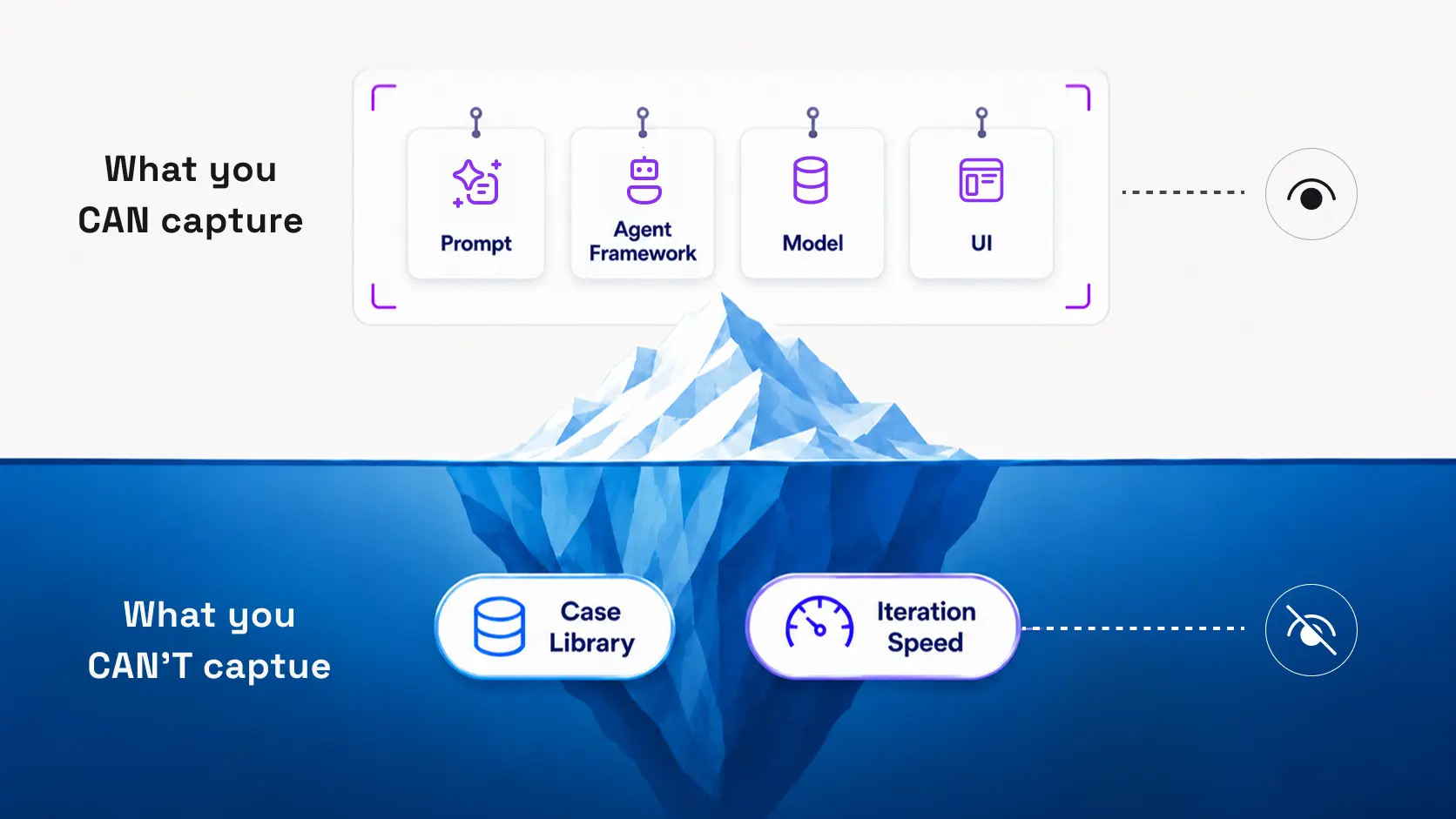
Only two things are not in the screenshot, and they are also the only two things that cannot be copied:
- Your own data store, real conversations, in the actual words of real users, in your exact use case. It is specific to your context and accumulated over time: a competitor who starts collecting today will still need exactly as much time as you have put in to catch up with the data you have right now.
- Operating speed is not about hard work, it is a mechanism. A team with the three workstreams running in parallel detects problems automatically, attributes them to categorized causes, and verifies fixes automatically, so one loop can shrink to a single day. A team with no system waits for users to complain, guesses at the cause, and types in a few test prompts to see whether the error is gone, which makes one fix cycle take a whole week, with no guarantee the fix is right. One week versus one day, sustained for a year, is an enormous gap in the number of fixes you get to make. And it compounds: each completed fix doesn't just remove one error, it adds one more piece of experience and information to your data store, making the next fix faster still.
So what about the big corporations? They have more people, more money and their own models, so surely their loop of self-repair and self-improvement must be even faster? The answer: the speed of fixing does not depend on how many people or how much money you have. It depends on whether the path from spotting an error to shipping the fix is short or long.
Big companies are good at making AI more powerful and at building more tools. That is a general strength. But your users will ask very specific questions that exist only in your particular product, and the big company doesn't have that information, because those are not its customers. For a small team like yours: spot the error in the morning, fix it by noon, ship it the same day. A big company doing the same piece of work has to go through document reviews, staged testing and coordination across many teams, which takes many more days.
So the moat is not that you are better than the big company in general. It is that on your own small patch of ground, you can turn faster than anyone else. But this only holds if you actually do the three jobs above, not if you "launch first and figure it out later". Recording user behavior, building the test suite, classifying the causes of failures: all of it has to happen from the very beginning. Leave it for later, and the most valuable three months of data are already lost, or stored incompletely and unusable.
Proving your ability in the age of AI
Writing "I once built an AI product" on a job application no longer impresses anyone. AI has made producing a demo so easy that everybody has one to talk about.
The question that really separates levels is this: after launch, how many versions have you shipped, and why each one?
Someone who can answer will be able to tell you: version three happened because we noticed a group of users kept asking again about the same thing. Tracing the cause, we found that retrieval wasn't finding the right documents. We added a query-rewriting layer, and the re-asking rate dropped from this number to that number.
The nice part is that you don't need a spectacular product to gain experience that is truly valuable. A product with only 100 users, where you stay close to exactly those 100 people, listening and fixing continuously for 6 months, still gives you far more experience than someone who built 10 demos and abandoned them all, none of them going anywhere.
Conclusion
Your product launch post is not the finish line. It is only the starting point.
The important question is not "what product have you built". It is: when will you write the second post, the one that says "After 3 months of listening to real users, here is what I have updated"?
References
- Andrej Karpathy, the original post on "vibe coding" on X, February 2025; and his talk at the AI Ascent event (Sequoia Capital), April 2026, on the successor concept "agentic engineering".
- CB Insights, analysis of the causes of startup failure based on post-mortems published by founders - "no market need" accounts for 42%, at the top of the list.
- Lingjiao Chen, Matei Zaharia, James Zou (Stanford University, UC Berkeley), "How Is ChatGPT's Behavior Changing over Time?", arXiv:2307.09009, 2023.
- Veracode, 2025 GenAI Code Security Report - an analysis of 80 coding tasks across more than 100 large language models, published July 30, 2025.