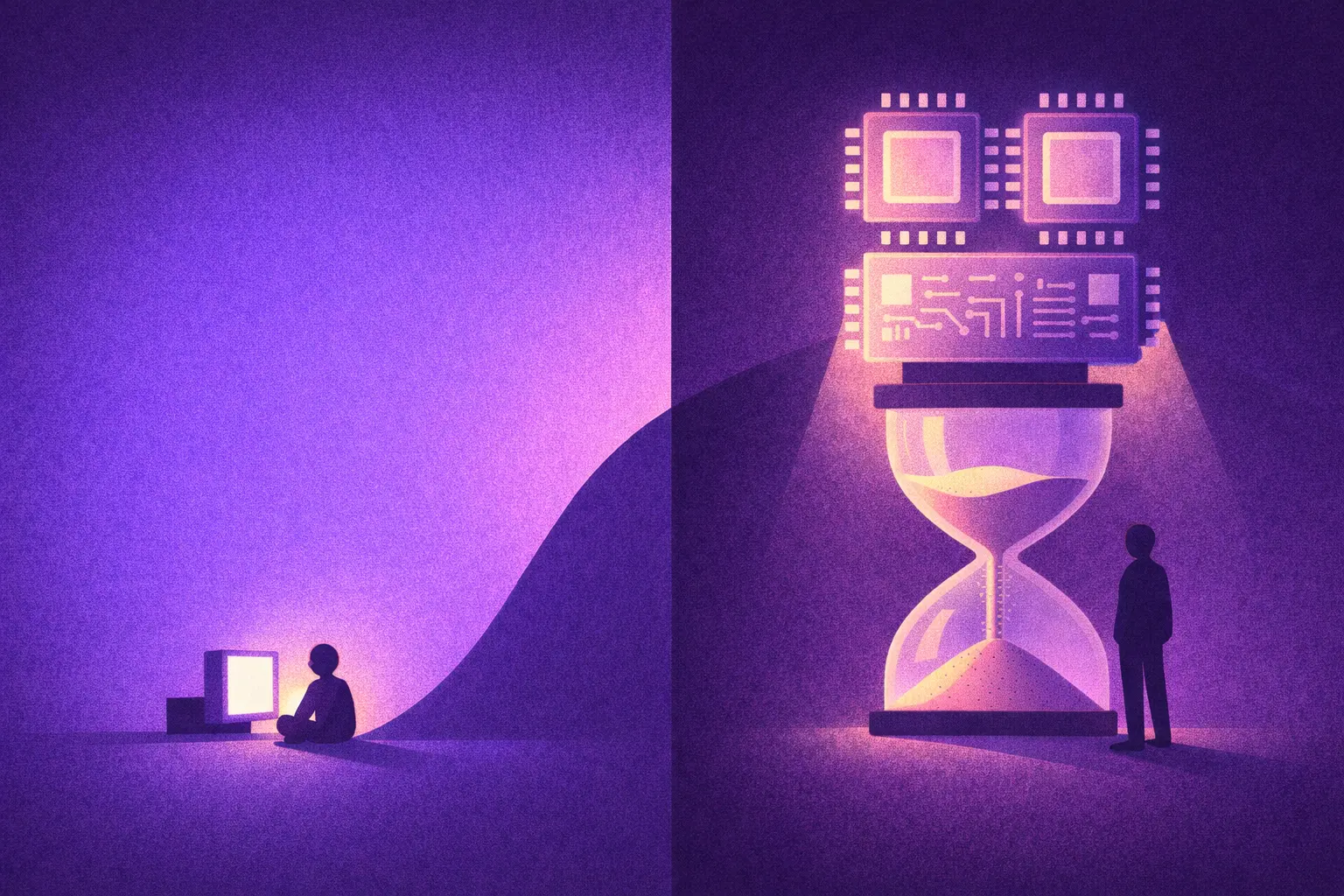
AI-native designer: designing in the AI era and rethinking the old design process
AI does not replace the design thinking of people who build products. It amplifies it exponentially. The designer's pivotal role now is knowing when to bring AI in, when to stay in control, and making sure every solution serves people and business goals.


The Dawn of a New Era
In recent years, artificial intelligence (AI) has made its way into almost every industry, and design is no exception. According to a McKinsey report (2023), around 65% of organizations are regularly using generative AI, including to support their design process. But we are not just talking about helpful tools here. We are witnessing the birth of an entirely new model: the AI-Native Designer.
The concept goes well beyond using AI as a tool. It represents a new design mindset, one in which AI is not an accessory but a core component of the creative and decision-making process. This shift is fundamentally reshaping the traditional design model.
Design Frameworks Are Being Applied Faster and More Widely
For decades, the design process has been shaped by models such as Design Thinking (Stanford d.school) and the Double Diamond (UK Design Council), with their familiar stages: research, ideation, prototyping, testing, and implementation.
The AI era is not making these models obsolete. It is pushing them to evolve:
- Acceleration with depth: AI shortens the time needed for analysis, prototyping, and testing, but deliberate iteration and empathy remain at the center.
- Expanded capability: AI processes insights from millions of data points and recognizes patterns at scale, while design frameworks provide the methodology.
- Augmented skills: AI is an assistant to the designer, but it can "hallucinate", answer based on probability, or stay generic. Judgment, an understanding of cultural context, and strategic decisions still belong to human expertise.
- Personalization at scale: Combining data-driven insights from AI with human-centered design creates experiences that are both deep and consistent, as Spotify, Netflix, and Airbnb have shown.
Don Norman, the father of user experience design, has observed:
Machine learning will usher in "a golden age of design" by removing the drudgery and letting designers focus on creativity
This is not the end of the traditional models. It is the next chapter, one in which AI becomes a powerful tool in the hands of designers who put people at the center.
The Designer's New Role
As AI technology advances at speed, the designer's role is shifting from executor to strategic partner.
The work AI is taking on:
AI can now automate many tasks that used to eat up time:
- Running desk research quickly
- Spinning up a design system quickly
- Generating hundreds of interface variations from a single initial wireframe.
- Quickly producing icons and illustrations that follow an established style guide
- Running quick usability checks on individual screens (which the designer still has to double-check, of course)
And countless other tasks. This kind of repetitive work now gets done in minutes instead of the hours it used to take
Where we need to focus:
Instead of sitting and drawing every small detail, designers are now moving toward three key areas:
- Deeper involvement in product strategy: Designers need a deep understanding of the business model, the ability to analyze user data at scale, and a hand in shaping a product vision that fits the market goals.
- The ability to orchestrate AI: The value is not in knowing how to use the tools. It is in asking the right questions, setting up precise context, and guiding AI toward results that match the design intent.
- Judgment and refinement: Designers need to evaluate AI output through the lens of aesthetics, user needs, brand values, and ethical considerations. This is something AI cannot do on its own.
Why is integrating with AI the most effective way to work?
Cam Worboys, Head of Product Design at Cash App, put it this way: "When everything can be made and everything starts to look the same, who wins? The people who know what should exist, not just what can exist."
The future belongs to designers who deeply understand their own organization. Not as the person who just "makes the interface pretty", but as a strategic team member who understands the business context, the technical constraints, and the company's overall goals.
A full understanding of your working environment, the project context, the real challenges, and the business direction is precisely what sets a designer apart from AI. It is how you demonstrate value that cannot be replaced.
AI Is Redefining How Value Is Created
AI is moving from a supporting tool to a strategic assistant in the design process. It helps us approach problems from more angles, automate workflows, and produce design variations, prototypes, and design systems faster, freeing up time for strategic thinking and deeper creative work.
Platforms such as Figma AI, Relume, Stitch by Google and others, and beyond them the dedicated AI agents for each stage of design, require designers to understand how to "ask the right questions", how to shape and control the output and, most important of all, when to use AI and when not to.
A designer's value no longer lies only in speed of execution. It lies in the ability to orchestrate AI's capabilities and human understanding to create impact that genuinely matters.
Below are a few things worth considering now that AI has become as powerful as it is.
Always Tie Every Design Decision to a Business Outcome
Every small detail in a design can have a big impact once it is multiplied at scale. Say that during testing you find that 5% of users cannot find the "Continue" button. That sounds small, but if your product has 250,000 users, it means 12,500 people are "stuck". They cannot go on using the service, they don't make a purchase, and they may leave for good.
You need to think at the scale your business operates at. Ask yourself:
- If users give up halfway, what does the company lose? (Ad spend? Customers to a competitor? A lower conversion rate?)
- Why is the company investing in this project? (What are the benefits for the business and for users? What does the project cost to build? Which metrics define success?)
- Why does this problem matter more than the others? (Why prioritize this one? How does it affect the business? Is it the root cause, so that solving it prevents similar problems from coming up later?)
In short: Don't just think "this design looks better" or "this experience is better". Think "this design helps the company lift conversion by <xx>%, equivalent to <xx> billion in revenue each quarter". That is the language executives understand and value.
Proactively Connect With Other Teams From the Start
When you have just joined a company or a project, make the most of the newcomer's advantage: you are allowed to ask questions without being seen as lacking expertise. In your first 90 days, the phrase "I'm new, and I'd like to understand this better" is the key that opens the door to deep conversations.
When you hit an obstacle or lack the answer to a business question, don't wait for formal meetings. Take the initiative and set up short 15-minute conversations with:
- The engineering lead, to understand technical constraints and capabilities
- The Product Owner, to grasp priorities and the thinking behind the product roadmap
- The sales and customer support teams, to hear about real problems and pain points
- The Business Owner, to understand the cost structure and what the project is expected to deliver economically
Use AI With a Systems Mindset Instead of One Output at a Time
When AI can generate a whole range of design options in a very short time, the designer's role no longer stops at producing individual screens or individual assets. We need to focus on designing the system that helps AI produce output that is on target from the start, including brand rules, UX principles, technical constraints, and quality standards.
Each design decision now affects not just one product but potentially hundreds or thousands of outputs generated afterward. Instead of asking "Is this design ready to use right now?", the AI-Native Designer asks "If I prompt AI with this logic to generate many different versions down the line, will the results still be good for users and for the business?"
Learn to Present Design With Numbers and Outcomes
Stop presenting ideas with vague phrases like "this improves the user experience."
Marina Krutchinsky of UX Mentor Diaries notes: "Saying your work is 'user-centered' is like saying your surgeon washed their hands before surgery. It's the minimum expectation, not a selling point."
Once you understand the business context behind your design decisions, start speaking in those terms. Focus on explaining why the problem happens, not just what needs fixing.
Instead of: "Designing the onboarding flow this way will be more intuitive."
Say: "Right now 68% of users drop off partway through because they have to fill in too much information. If we cut that down and pre-fill part of it from user data, we can bring the drop-off rate down to around 25%."
The journey to becoming a strategic partner does not happen overnight. But by starting with these three steps - mapping decisions to business impact, building cross-functional relationships, and learning the language of impact - you will gradually shift from someone who executes to someone who shapes product strategy.
Conclusion
At this point, design is no longer just a race to see who works faster or who makes the prettier thing. The real value lies in understanding how the product operates within the bigger business picture, and using design to directly influence that outcome. When you understand the users, the numbers, the costs, and the pressures on each department in the company, you are no longer the person who "makes screens". You become the person who helps the business make the right decisions.
When you operate as an integrated designer, you become invaluable because you:
- Prevent costly mistakes before they get built, by understanding the business constraints
- Spot opportunities others miss, by deeply understanding user behavior and business metrics
- Bridge the communication gap between engineering and business teams
- Make decisions faster, because you have the full context
Most important of all, you become irreplaceable by AI, because your value does not lie in the deliverables you produce. It lies in the strategic thinking that informed those decisions.
The question is not whether you can make something beautiful.
It is whether your business partners trust you when things go wrong.
References
- McKinsey & Company. (2023). The state of AI in 2023: Generative AI's breakout year. https://www.mckinsey.com/capabilities/quantumblack/our-insights/the-state-of-ai-in-2023-generative-ais-breakout-year
- Navigating the Future of Design: Don Norman on UX, AI, and Design Leadership
- Krutchinsky, M. (2025). You sound like you're selling cupcakes, not solving business problems. UX Mentor Diaries. https://uxmentor.substack.com/p/you-sound-like-youre-selling-cupcakes
- Worboys, C. (2025). What can be made, what should be made. Hatch Conference Keynote. https://www.hatchconference.com/speakers/cam-worboys + https://www.youtube.com/watch?v=KyOMQJUxQ28
- State of AI in Design. (2025). State of AI in Design Report 2025. https://www.stateofaidesign.com/report